Report Release: Pathways to Unlocking Clean Energy Scale under Malaysia's CRESS
The Asia Clean Energy Coalition (ACEC) has released a two-page executive summary of its Malaysia Corporate Renewable Energy Supply Scheme (CRESS) survey, highlighting strong interest from both corporate buyers and renewable energy developers in advancing corporate clean energy procurement in Malaysia.
The survey findings point to a clear opportunity: the fundamental conditions for CRESS to succeed are already in place. Corporate buyers are actively exploring renewable electricity procurement options, while developers have indicated readiness to bring forward new project capacity. However, the results also show that market uptake remains at an early stage, with a gap between underlying interest and actual transaction execution.
Strong Buyer Interest, but Greater Clarity Needed
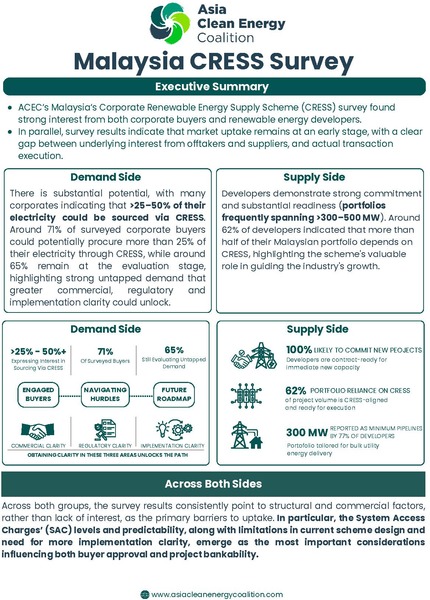
On the demand side, surveyed corporate buyers indicated significant potential for renewable electricity procurement through CRESS. Many buyers noted that more than 25–50% of their electricity could potentially be sourced through the scheme, reflecting strong underlying demand from corporates seeking credible clean energy procurement pathways.
At the same time, around 71% of surveyed buyers indicated potential interest in procuring more than 25% of their electricity through CRESS, while 65% remain at the evaluation stage. This suggests that many corporates are actively considering the scheme, but still require greater commercial, regulatory, and implementation clarity before moving towards execution.
For large electricity users, including data centres, manufacturers, and other energy-intensive sectors, CRESS has the potential to support decarbonisation goals while strengthening Malaysia’s attractiveness as a destination for sustainable industrial growth. Unlocking this demand will require clear implementation pathways that support internal business case development and long-term procurement decisions.
Developers Are Ready to Commit New Capacity
On the supply side, renewable energy developers demonstrated strong commitment and readiness to support CRESS. Developers surveyed reported portfolios frequently spanning 300–500 MW, with 77% indicating minimum pipelines of 300 MW.
The survey also found that developers are contract-ready for immediate new capacity, while 62% indicated that more than half of their Malaysian portfolio depends on CRESS. This highlights the scheme’s important role in guiding future renewable energy investment and project development in Malaysia.
However, developers also noted that bankability remains closely linked to implementation certainty. In particular, clarity around System Access Charges (SAC), grid allocation, nodal capacity, Battery Energy Storage System (BESS) dispatch arrangements, contractual terms, and fallback revenue mechanisms will be important to support investment decisions and financing.
Key Areas for Refinement
Across both buyers and developers, the survey results consistently point to structural and commercial factors as the main barriers to uptake, rather than lack of interest.
The most important areas identified include SAC transparency and predictability, excess energy treatment, contractual clarity, implementation visibility, and overall project bankability.
For buyers, greater SAC transparency would directly support business case development and 21-year contract viability. A clearer framework for excess energy, such as a transparent sell-back or reference pricing mechanism, could also help optimise system sizing and improve renewable energy utilisation.
For developers, SAC uncertainty is viewed as a key bankability risk that may affect pricing and required returns. Developers also seek greater visibility on grid and nodal allocation, as well as BESS dispatch arrangements, to finalise project design and improve financing confidence.
Supporting Bankable Corporate Clean Energy Procurement
ACEC’s survey points to five practical areas where targeted refinements could help unlock CRESS execution.
First, enhancing visibility into SAC’s long-term trajectory would provide stakeholders with greater cost certainty over the contract tenor. This could include exploring fixed or inflation-adjusted rates for 21-year terms.
Second, a transparent framework for excess energy treatment would help support efficient system design and optimal renewable penetration.
Third, clearer contractual guidance, including CRESA reference templates and early guidance on how SAC interacts with other grid, network, and capacity charges, would streamline negotiations and internal review processes.
Fourth, stronger implementation visibility and coordination would help buyers and developers plan more efficiently, particularly around approval timelines and grid capacity assessments.
Finally, a broader focus on project bankability, including offtaker credit profiles, tariff evolution, and grid connection arrangements, would support developers in securing capital and bringing projects to execution.
A Collaborative Path Forward
Malaysia’s CRESS framework represents an important step in expanding corporate renewable energy procurement options and enabling greater private-sector participation in the country’s energy transition.
The survey shows that both demand and supply are present. The next phase will depend on translating this interest into bankable transactions through targeted refinements that improve confidence, reduce uncertainty, and support implementation.
ACEC looks forward to continuing constructive engagement with policymakers, regulators, developers, corporate buyers, financial institutions, and other stakeholders to support the successful development of CRESS and accelerate renewable energy deployment in Malaysia.